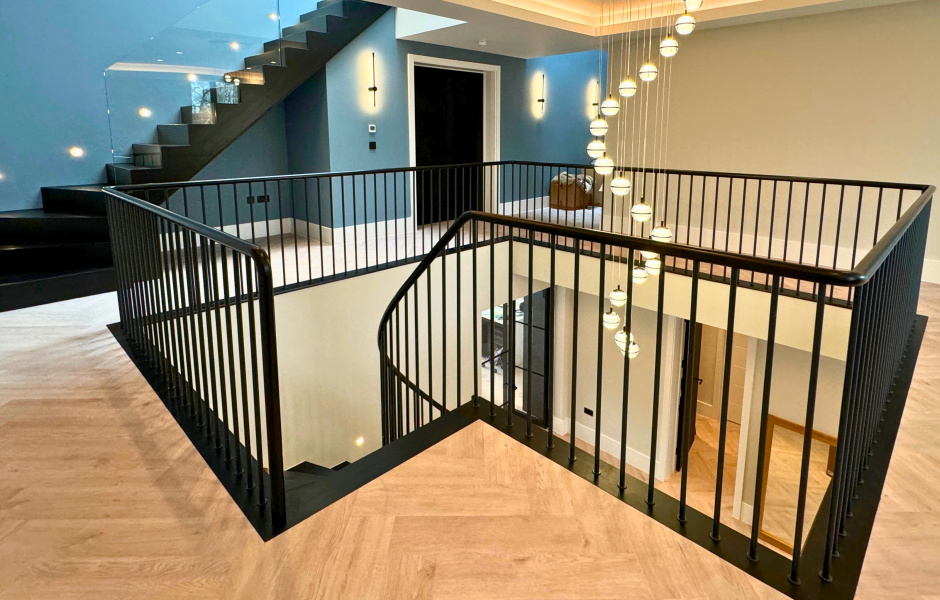
The unsung backbone of every staircase — how this critical structural element works, what types exist, and why getting it right matters.
Walk up any staircase — in a factory, a modern home, or a commercial building — and you're trusting an element you almost certainly never notice. The stair stringer is the inclined structural member that runs along the side (or beneath) a staircase, carrying the load of every tread, every riser, and every person who walks upon it.
When that stringer is made from steel, it becomes one of the most versatile, durable, and load-bearing components in modern construction. This guide breaks down everything you need to know.
A stair stringer is the angled support beam that gives a staircase its structural integrity. Think of it as the "spine" of the stairs. Stringers run diagonally from one floor level to another, and the treads (horizontal surfaces you step on) and risers (vertical panels between treads) attach directly to them.
Steel stringers are fabricated from structural steel sections — most commonly C-channel, I-beam, or flat plate — and are favoured wherever strength, longevity, fire resistance, or a distinctive industrial aesthetic is required.
A stringer doesn't just hold up stairs. It defines the geometry of the entire staircase — its pitch, its rhythm, and ultimately how safe and comfortable it is to use.
Types of steel stair stringers
Not all stringers are created equal. The profile you choose affects the staircase's look, cost, load capacity, and ease of installation.
Closed (box) stringer
A solid steel plate or channel with no exposed saw-tooth cut. Treads sit on top of welded brackets. Clean, modern appearance. Common in commercial buildings.
Open (saw-tooth) stringer
The stringer is notched in a stepped profile to accept treads and risers. Treads are visible from the side. Classic industrial look. Easy tread replacement.
Mono stringer
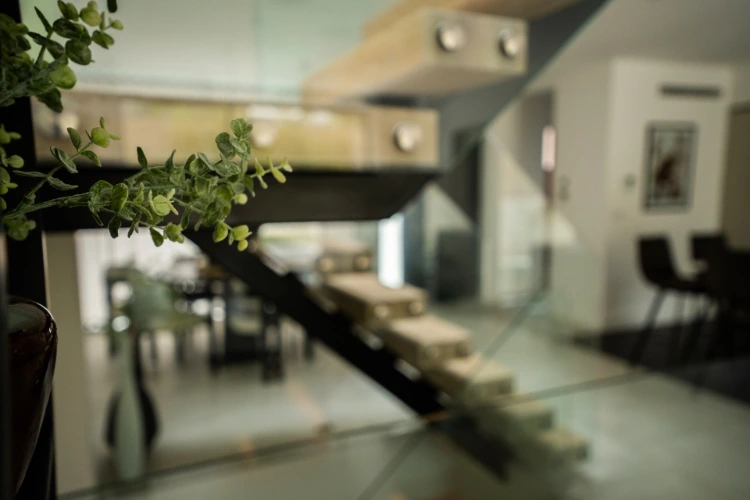
A single central spine, typically a rectangular hollow section (RHS), from which treads cantilever on both sides. Architecturally dramatic, highly contemporary.
Double / twin stringer
Two parallel stringers (one on each side), the most common configuration for residential and commercial stairs. Maximum stability and load sharing.
Key components and terminology
| Term | What it means | Typical steel spec |
|---|---|---|
| Rise | Vertical height of each step | 150–220 mm (UK Building Regs) |
| Going / run | Horizontal depth of each tread | 220–300 mm minimum |
| Pitch | Angle of the stringer to the horizontal | Typically 30°–42° |
| Waist thickness | Thinnest point of the stringer at a notch | Min. 6 mm for most residential |
| Tread plate | Checkered or grated steel tread surface | 3–5 mm mild or stainless steel |
| Nosing | Protruding front edge of tread | Max. 25 mm overhang (UK regs) |
Materials and finishes
Steel stringers are most commonly made from mild steel (S275 or S355 grade), but the choice of finish dramatically changes the staircase's character and durability:
Hot-dip galvanised
Best for external or industrial environments. The zinc coating provides 40–70 years of corrosion protection. Slightly rough surface texture — often left exposed in warehouses and fire escapes.
Powder coated
The finish of choice for commercial interiors. Available in any RAL colour, powder coating gives a smooth, tough surface that resists chipping and fading. Black (RAL 9005) is the dominant contemporary choice.
Stainless steel
Grade 316 stainless is specified for marine environments or premium architectural installations. Naturally corrosion-resistant, no coating required. Significantly higher material cost.
Weathered / raw steel
Left untreated or deliberately rusted (Corten-style), raw steel stringers create a moody, industrial aesthetic favoured in loft conversions and creative workspaces. Requires a sealing topcoat to stop active corrosion indoors.
Building regulations note (UK): Under Approved Document K, domestic staircases must have a maximum rise of 220 mm and minimum going of 220 mm. Structural steel stringers must be designed by a qualified structural engineer for any load-bearing application. Always obtain the relevant building control approval before installation.
How steel stringers are fabricated
The fabrication process follows a precise sequence. First, a structural engineer calculates the required section size based on span, load, and pitch. The steel is then cut to length — usually by plasma or laser — and the notches or bracket positions are marked out and cut. Tread support brackets are welded or bolted in place. The completed stringer is then blasted, primed, and finished before delivery to site.
Tolerances matter enormously. A difference of even 2–3 mm in notch depth across a flight will produce a staircase with uneven rise heights, which is both a building regulation failure and a tripping hazard.
Installation: what to expect
Steel stringers are typically craned or manhandled into position and bolted to structural connections at the top and bottom — either to a landing beam, a concrete slab, or a dedicated steel upstand. Once the stringers are level, plumb, and securely fixed, treads and risers are fitted, followed by balustrades and handrails.
A typical residential steel staircase can be installed by an experienced team in one to two days once the stringers are on site. The steelwork lead time — from order to delivery — usually runs four to eight weeks for bespoke fabrication.
Why choose steel over timber or concrete?
Timber is warm and familiar, but susceptible to moisture, fire, and heavy wear. Concrete is supremely durable, but expensive to form and difficult to modify. Steel hits a powerful middle ground: it is strong in both tension and compression, non-combustible, dimensionally stable, and entirely recyclable. In slender, open-plan spaces where a timber stringer would need to be bulky to carry the load, a steel stringer can achieve the same span in a far smaller profile.
The visual language of exposed steel also continues to grow in popularity — from minimalist residential projects to contemporary office fit-outs — making steel stringers as much a design statement as a structural solution.
In summary
A steel stair stringer is the load-bearing diagonal spine of a staircase, fabricated from structural steel and available in open, closed, mono, or twin configurations. The right choice depends on your load requirements, aesthetic goals, environment, and budget — but in almost every case, steel delivers unmatched strength, longevity, and design flexibility.