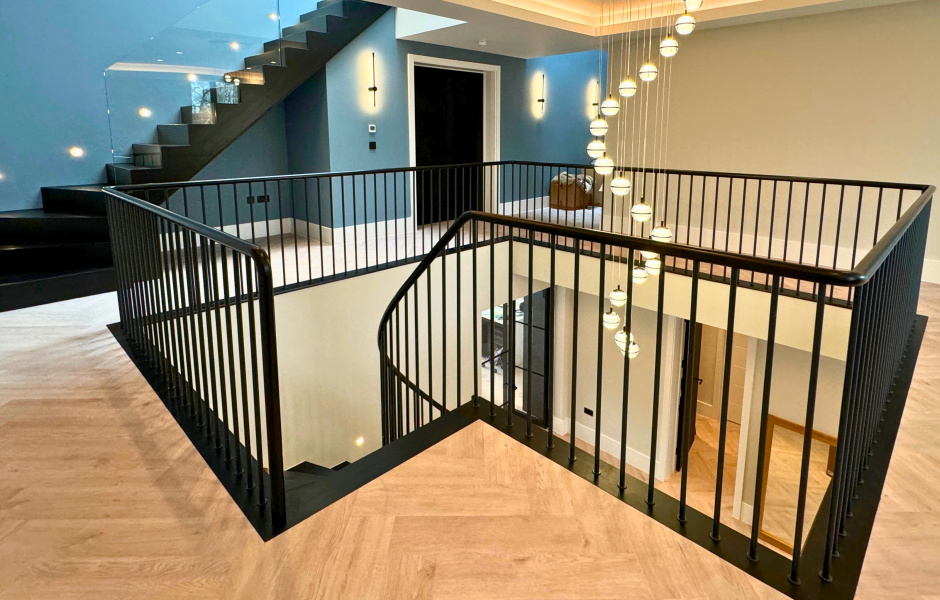
The spiral staircase is not merely an architectural contrivance; it is an artifact of human ingenuity shaped by necessity and aspiration. Its earliest incarnations appeared in ancient stone towers and medieval strongholds, where compact circulation was imperative. Within the fortified walls of castles and watchtowers, these helical structures economized space while offering defensive advantage. Ascending clockwise, they favoured right-handed defenders—a subtle yet deliberate tactical nuance.
Beyond utility, the spiral staircase accrued symbolic resonance. Its upward sweep suggested ascension, enlightenment, even transcendence. In ecclesiastical architecture, the spiral embodied spiritual pilgrimage—a metaphor etched in stone. The form evoked continuity without terminus, a visual soliloquy on infinity itself. Thus, from inception, the spiral staircase was both pragmatic and poetic.
Spiral Staircase Installation
A. The 100 mm Sphere Gap Rule
The installation of a spiral staircase is not governed by aesthetics alone. Regulation is paramount. Among the most critical requirements is the 100 mm sphere gap rule—a standard that safeguards occupants and ensures structural prudence.
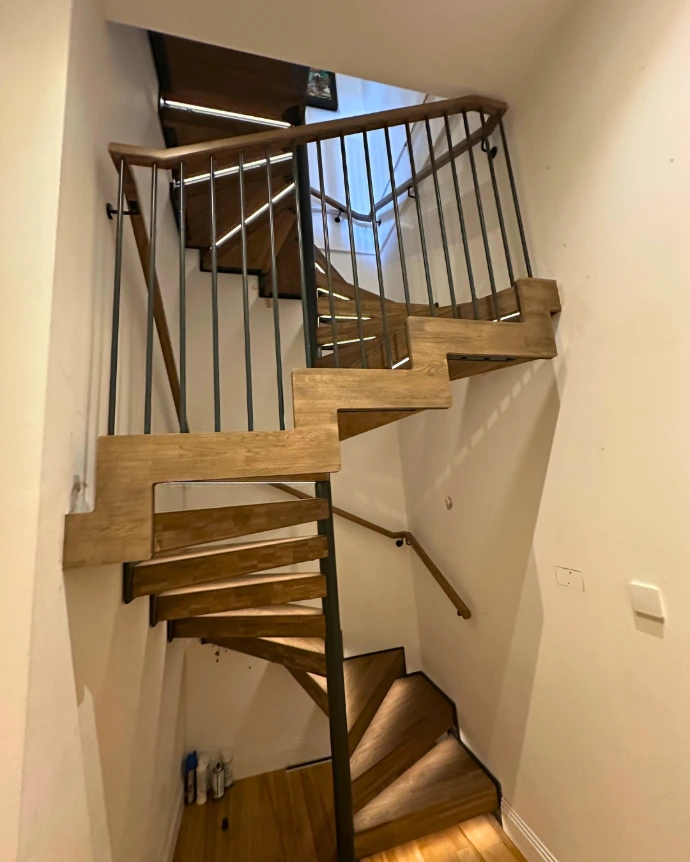
This rule stipulates that no opening within the balustrade or between individual treads may permit the passage of a 100 mm sphere. In practical terms, this means that the gap must never exceed 99 mm. The intention is unequivocal: to prevent small children from slipping through balusters or becoming entrapped within hazardous voids.
Such dimensional precision may appear minute. It is not. It is the difference between compliance and contravention. Between safety and liability. Every baluster spacing, every tread junction, must be scrutinised with exacting care. The elegance of a spiral staircase must rest upon measurable integrity.
B. Distinguishing Between Primary and Secondary Staircases
Not all spiral staircases serve identical purposes. Regulations differentiate between primary staircases—those providing access to habitable rooms such as bedrooms, bathrooms, and principal living areas—and secondary staircases intended for ancillary spaces.
If a spiral staircase connects a hallway to occupied rooms, it must comply fully with building regulations, including the 100 mm rule. These installations are classified as main staircases. They are not optional features; they are essential circulation routes within the home.
Conversely, staircases leading to loft conversions, mezzanine floors, home offices, playrooms, or occasional-use spaces are typically regarded as secondary or non-habitable access points. In these cases, regulatory expectations may be less stringent, permitting more basic models. The distinction is decisive. Selecting the incorrect category can render an installation non-compliant.
Planning and Design Considerations Before Installation
A. Measuring Space and Assessing Suitability
Precision begins long before installation day. Accurate measurement of the available aperture and floor-to-floor height is indispensable. A spiral staircase, though space-saving by nature, must integrate seamlessly within its designated footprint.
Clearances, headroom, and circulation flow demand scrutiny. An undersized diameter may compromise comfort. An oversized structure may overwhelm the room. Geometry must be reconciled with practicality.
Equally important is the determination of the staircase’s function. Is it providing access to habitable bedrooms and bathrooms? Or to a mezzanine retreat? The answer dictates the model selection and regulatory pathway.
B. Compliance, Safety, and Sculptural Presence in Modern Homes
Spiral staircases are inherently space-saving. They occupy a compact footprint while delivering vertical mobility with sculptural distinction. Indeed, within contemporary interiors, they often resemble kinetic art installations—functional sculptures that elevate a home’s infrastructure.
Modern designs frequently embrace bright colours and crisp finishes, presenting the staircase as a statement of innovation. Smart in conception and refined in execution, today’s spiral staircases reconcile regulation with radiance.
Yet beneath the chromatic vibrancy and elegant curvature lies rigorous compliance. Local building and safety regulations must always be satisfied. Safety is foundational. Style is consequential.
When thoughtfully selected and meticulously installed, a spiral staircase transcends its utilitarian origins. It conserves space. It enhances circulation. It stands, poised and ascending, as both engineering achievement and architectural adornment.
Contact us for a free consultation sales@ovoms.com